Showing posts with label Articles. Show all posts

Mar 27, 2014

R.C. Sproul, Jr.

How Should We Understand the Promise Jesus Makes in John 14:14, “If You Ask Anything in My Name I Will Do It?”

                 Mar 22, 2014 
           
"My book, Believing God, was written with a single goal in mind, to help believers enter more fully into the promises of God. Even we who affirm that God’s Word is always true still struggle to believe that if we ask for wisdom He will give it to us (James 1:5), that children are a blessing from the Lord (Psalm 127), that we will be like Him for we shall see Him as He is (I John 3:4). Having pushed for greater faith, greater confidence, what ought I to say about this promise, that honestly on its face looks to over-promise?

We have a number of caveats that at least seek to place limits on what Jesus must have meant. We affirm, for instance, that, “In My name” at least excludes our more crass requests. Janis Joplin was not standing on solid exegetical grounds when she prayed, “Lord won’t you buy me a Mercedes-Benz.”

But what about when we are asking for things we know God would approve of? In my home I and the children pray nightly that God would be pleased to help us to grow in grace and wisdom. What we are seeking is that we would be made fully into the image of Christ, that our sanctification would be complete. That sounds like a good thing to ask in Jesus name. Second, every night we pray that God would be pleased to magnify His name by rising up and protecting all the unborn in Orlando, Florida, these United States, and around the world. How could that not be a prayer in His name? And yet, thus far our prayers have not been answered.

The reason the prayers haven’t been answered is not too complex. God has determined to glorify His name in the battles, in my pursuit of godliness, in my repentance for my failure. He has determined to glorify His name in the battle over the little babies. He certainly could end all of history whenever He wishes, making all things right. But such is clearly not His will.

The more difficult question then, given His will is not to complete history now, is what did Jesus mean when He said that what we ask in His name He would grant. My answer is this- He will so grant. My hearts desire is that I would be like Him. And He is busy making that happen. My hearts desire is that all the babies would be safe in their mothers’ wombs. And He is busy making that happen. A day will come when both of these desires will come to pass, and Jesus is moving history forward to that day.

These two principles come together when we remember the fullness of what it means to pray in Christ’s name—it is to seek, ultimately, the one thing He is seeking, the glory of God. My sanctification, even the rescue of the unborn, these are proximate goals, subservient to the greatest goal, that God would be glorified. Which is why, in the end, every time we pray in His name we pray with His humble submission—Nevertheless not My will but Thine be done."

Dec 22, 2013

God Prepared His Son for Christmas


John 1:14The Word became flesh and made his dwelling among us. We have seen his glory, the glory of the one and only Son, who came from the Father, full of grace and truth.

"Tiny hands waving about uncontrollably. A shrill cry piercing the damp air of a borrowed cave. A mother’s peaceful smile. A mysterious smile on the face of her husband who helped deliver a miracle. The Word became flesh: God confined to an infant.

Growing hands pointing to ancient scrolls. An adolescent voice asking and answering questions. The teachers amazed. A mother who “treasured all these things in her heart.” The Father smiling with favor. The Word became flesh: God growing in stature.

Gentle hands touching blind eyes, deaf ears and withered limbs. Powerful hands turning water into wine, feeding multitudes with a single meal and touching life into lifeless bodies. Thankful faces without words to express their gratitude. The Word became flesh: The Father glorified through the Son.

Constricted hands, the result of spikes driven through his wrists. Arms outstretched, fastened to a wooden beam. A mother stands below feeling every painful throb as her own. The just Father turns his back on his Son. The Word became flesh: Our sins on Jesus.

Scarred hands in resurrected glory. A chariot of clouds lifting him to the Father. A joyful mother watching her son ascend. A promise from the lips of the risen Savior: Just as I go, I will return again. The Word became flesh: Resurrection assurance.

Open hands inviting every sinner. Accepting all who come to him in faith. Blind eyes see; prison doors are opened. The prince or pauper, none are turned away. Eternal life to all who believe. The Word became flesh: Sinful man in communion with the holy God!

Lord Jesus, thank you for leaving the indescribable brilliance of heaven to become man. Thank you for coming to us so that we could come to you. Amen." 


by Ron Moore, The Journey Radio Ministry

Mar 28, 2013

The Trials of This Earth Shall Pass


"This too shall pass” a phrase commonly heard by those going through periods of mourning or struggle. When viewed in an earthly sense, it can be difficult to believe, since we know struggles often pass only to bring forth different struggles. This life is never free of suffering. Instead, we move through life and its trials, attempting to make it through by leaning on God, and doing our best to glorify him in the process.


Throughout Isaiah 33, a beautiful reminder is painted. A glorious image of the future, paired with the mournful present—a reminder that though we will struggle tremendously throughout this life, we will someday rejoice in the presence of God’s glory.

Rejoicing through forgiveness

Not only will we live in the most perfect place, in the presence of God; we’ll be completely forgiven of our past (Isaiah 33:24). We will be completely free to rejoice and enjoy life in God’s presence, free of guilt and regret. And this all began on the cross with Jesus.

Because of Jesus’ death on the cross, we are able to look forward to one day living in total happiness. We are able push onward because the mourning and sadness that this world holds for us are only temporary. We know that this won’t last forever, so we are able to push forward each day, looking forward to the day when we meet our father and live in the glorious home he has prepared for us.

Looking forward to heaven

“If then you have been raised with Christ, seek the things that are above, where Christ is, seated at the right hand of God. Set your minds on things that are above, not on things that are on earth. For you have died, and your life is hidden with Christ in God. When Christ who is your life appears, then you also will appear with him in glory.”—Colossians 3:1–4

If it were not for Jesus coming to die, death would be something to dread—a terrible ending to a difficult life. However, we have been given a gift leading to an even more beautiful beginning. Because of God’s grace and forgiveness, we are able to look onward to the place where the Lord in majesty will be for us (Isaiah 33:21).

Easter is an amazing reminder of the fact that “this too shall pass.” Though we go through dark times, times of mourning, loss, and disappointment, we get to look forward to living forever as though we are blameless and perfect, just as we appear because of what Jesus endured for our sake."

by Tayler Beede
Logostalk


Mar 3, 2013

The Word-less Church


Many American churches are in a mess. Theologically they are indifferent, confused, or dangerously wrong. Liturgically they are the captives of superficial fads. Morally they live lives indistinguishable from the world. They often have a lot of people, money, and activities. But are they really churches, or have they degenerated into peculiar clubs?
 
What has gone wrong? At the heart of the mess is a simple phenomenon: the churches seem to have lost a love for and confidence in the Word of God. They still carry Bibles and declare the authority of the Scriptures. They still have sermons based on Bible verses and still have Bible study classes. But not much of the Bible is actually read in their services. Their sermons and studies usually do not examine the Bible to see what it thinks is important for the people of God. Increasingly they treat the Bible as tidbits of poetic inspiration, of pop psychology, and of self-help advice. Congregations where the Bible is ignored or abused are in the gravest peril. Churches that depart from the Word will soon find that God has departed from them.
 
What solution does the Bible teach for this sad situation? The short but profound answer is given by Paul in Colossians 3:16: “Let the word of Christ dwell in you richly, teaching and admonishing one another in all wisdom, singing psalms and hymns and spiritual songs, with thankfulness in your hearts to God.” We need the Word to dwell in us richly so that we will know the truths that God thinks are most important and so that we will know His purposes and priorities. We need to be concerned less about “felt-needs” and more about the real needs of lost sinners as taught in the Bible.
Paul not only calls us here to have the Word dwell in us richly, but shows us what that rich experience of the Word looks like. He shows us that in three points. (Paul was a preacher, after all.)
 
First, he calls us to be educated by the Word, which will lead us on to ever-richer wisdom by “teaching and admonishing one another.”
Paul is reminding us that the Word must be taught and applied to us as a part of it dwelling richly in us. The church must encourage and facilitate such teaching whether in preaching, Bible studies, reading, or conversations. We must be growing in the Word.
 
It is not just information, however, that we are to be gathering from the Word. We must be growing in a knowledge of the will of God for us: “And so, from the day we heard, we have not ceased to pray for you, asking that you may be filled with the knowledge of his will in all spiritual wisdom and understanding” (Col. 1:9). Knowing the will of God will make us wise and in that wisdom we will be renewed in the image of our Creator, an image so damaged by sin: “Put on the new self, which is being renewed in knowledge after the image of its creator” (3:10).
 
This wisdom will also reorder our priorities and purposes, from that which is worldly to that which is heavenly: “The hope laid up for you in heaven. Of this you have heard before in the word of truth, the gospel” (1:5). When that Word dwells in us richly we can be confident that we know the full will of God: “I became a minister according to the stewardship from God that was given to me for you, to make the word of God fully known” (1:25). From the Bible we know all that we need for salvation and godliness.
 
Second, Paul calls us to expressing the Word from ever-renewed hearts in our “singing.”
Interestingly, Paul connects the Word dwelling in us richly with singing. He reminds us that singing is an invaluable means of placing the truth of God deep in our minds and hearts. I have known of elderly Christians far gone with Alzheimer’s disease who can still sing songs of praise to God. Singing also helps connect truth to our emotions. It helps us experience the encouragement and assurance of our faith: “That their hearts may be encouraged, being knit together in love, to reach all the riches of full assurance of understanding and the knowledge of God’s mystery, which is Christ, in whom are hidden all the treasures of wisdom and knowledge”
(2:2–3).
 
The importance of singing, of course, makes the content of our songs vital. If we sing shallow, repetitive songs, we will not be hiding much of the Word in our hearts. But if we sing the Word itself in its fullness and richness, we will be making ourselves rich indeed. We need to remember that God has given us a book of songs, the Psalter, to help us in our singing.
 
Third, Paul calls us to remember the effect of the Word to make us a people with ever-ready “thanksgiving.”
Three times in Colossians 3:15–17 Paul calls us to thankfulness. When the “word of Christ” dwells in us richly, we will be led on to lives of gratitude. As we learn and contemplate all that God has done for us in creation, providence, and redemption, we will be filled with thanksgiving. As we recall His promises of forgiveness, renewal, preservation, and glory, we will live as a truly thankful people.
 
We need the word of Christ to dwell in us richly today more than ever. Then churches may escape being a mess and become the radiant body of Christ as God intended.

by W. Robert Godfrey
This post was originally published in Tabletalk magazine.
 

Jul 2, 2012

Our Walk, Part 2


Walk in the light of the Lord, free from all darkness—Isaiah 2:5

Walk on the highway of holiness, as one who has been redeemed—Isaiah 35:8-9

Walk without fainting, renewed in the strength of the Lord—Isaiah 40:31

Walk victorious through testing, knowing God will bring you through—Isaiah 43:2

Walk in the old paths, in the ways established by the Lord—Jeremiah 6:16

Walk humbly, daily realizing how much you need Him—Micah 6:8

Walk in newness of life, free from sin and selfishness—Romans 6:4

Walk according to the Spirit, in righteousness, peace, and joy—Romans 8:1

Walk properly, as children of the day—Romans 13:13

Walk in the steps of faith, confident of the Lord’s promises—2 Corinthians 5:7

Walk in good works, according to the things God has prepared—Ephesians 2:10

Walk worthy of your calling, seeking God’s approval—Ephesians 4:1

Walk in love, knowing the heart of God toward others— Ephesians 5:2

Walk purposefully, having your wits about you—Ephesians 5:15

Walk to please God, seeking to hear His “well done.”—1 Thessalonians 4:1

Walk orderly, doing your work as unto the Lord—2 Thessalonians 3:11

Walk as Jesus walked, letting Him live His life through you—1 John 2:6

by Roy Lessin

Jun 29, 2012

Our Walk, Part 1


Walk before the Lord, in a way that is pleasing to Him—Genesis 17:1


Walk in the ways of the Lord, knowing His word and His will—Deuteronomy 8:6

Walk after the Lord, with a heart that seeks to follow—Deuteronomy 13:4

Walk with the Lord with all our heart, without compromise, holding nothing back—1 Kings 8:23

Walk in the good way, which is always the righteous way—1 Kings 8:36

Walk in the fear of the Lord, departing from evil and growing in wisdom—Nehemiah 5:9

Walk in integrity, maintaining truth and honesty—Psalm 26:11

Walk uprightly, always going after the highest and best—Psalm 84:11

Walk in truth, always being teachable and a good student of the Word—Psalm 86:11

Walk in the light of His presence, desiring His approval upon your choices—Psalm 89:15

Walk at liberty, knowing true spiritual freedom—Psalm 119:45

Walk in clarity, free from all confusion—Psalm 143:8

Walk away from the path of sinners, not being deceived by sin—Proverbs 1:10-15

Walk safely, in wisdom and understanding—Proverbs 3:13-23

Walk without being spiritually hindered, making straight paths for your feet—Proverbs 4:12


by Roy Lessin


May 19, 2012

The Successful Church


The Successful Church

What does it take to be a successful church? Is there a minimum number that must be achieved in attendance or membership? Is there a certain quality that must be found in our worship and our preaching? Is it the size of our missions budget or the percentage of our total receipts that is given to missions?

Questions like these press upon us as we examine our corporate life as the church. We recognize the ever-present temptation to evaluate our congregations by worldly standards. We must, however, use biblical standards. Only as our churches conform to the Lord's plan and purpose for the church can we expect His word of commendation: "Well done, good and faithful servant."

Succeeding as a church should be central to our concerns, for it is central to God's concerns. The Bible ends with a vision of the church clothed with the glory of God (Rev. 21:11,23). Where the Bible ends should tell us a great deal concerning what it is all about. The great ascription of praise in Ephesians 3:20-21 gives us perhaps the Bible's most concise statement of the purpose of God, and it highlights for us the great purpose of the church: "Now to him who is able to do far more abundantly than all that we ask or think, according to the power at work within us, to him be glory in the church and in Christ Jesus throughout all generations, forever and ever. Amen."

Glory in the church - that is what makes a church successful. Only "in Christ Jesus" is this possible. What are the elements that make for His glory in the church? They are the same as those that make for the glory of God. Moses begged for a revelation of God's glory (Ex. 33:18). God granted this request, making all His goodness to pass before Moses as the name of the the LORD was proclaimed (v. 19). In this revelation, God enumerated His attributes.

The LORD, the LORD, a God merciful and gracious, slow to anger, and abounding in steadfast love and faithfulness, keeping steadfast love for thousands, forgiving iniquity and transgression and sin, but who will by no means clear the guilty, visiting the iniquity of the fathers on the children and the children's children, to the third and the fourth generation. (Exod. 34:6-7)

God's glory is the sum total of His attributes.

Here, then, is the measuring rod of the successful church. Is there to be found in our church a revelation of the glory of God? Do we manifest the character of our God in our worship, our service, our fellowship, our pastoral care, our outreach? Much as we are inclined to judge our success by empirically measurable goals, the important considerations have little to do with numbers. Indeed, it is encouraging to know that it takes very few to qualify.

Matthew 18 records that once the disciples came to Jesus and asked Him about greatness in the kingdom. They were principally asking about individual greatness, but as our Lord responded, we see that individual greatness and church greatness are all the same in the kingdom. Jesus placed a little child before the disciples and told them that they must humble themselves as this child in order to be great in the kingdom of heaven. He said they must receive the child "in My name."  Going on, He warned against causing such little ones to stumble. Jesus told them that His church would be like a good shepherd going in search of lost sheep (vv. 12-14), because it is not the will of the Father that even one of His little ones should perish. Then He outlined just how the lost sheep are to be sought:
first by individual appeal, then by one or two others, finally by the church itself (vv. 15-20). When lost sheep continue in their rebellion after many patient, persistent appeals, they are at last put out from the church, for the Lord's forgiveness is not endless toleration of sin. His glory is not ever-lasting indulgence. His character of mercy and steadfast love includes His justice, for He will by no means clear the guilty. Yet to those who do seek forgiveness, the Lord forgives seventy times seven, and so must we (vv. 21-35).

Notice how this chapter demonstrates the outworking of the character of God revealed to Moses in Exodus 34. There is mercy, steadfast love, and forgiveness of sin. Also, there is no clearance of the guilty, for those who persistently refuse the church's appeals are finally cut off as a warning that the same will be true at the last day if repentance is not forthcoming. But for those who do repent, there is grace abounding to the chief of sinners, even seventy times seven. This is the glory of God revealed in Jesus Christ. Even two or three gathered in His name and empowered by His presence can accomplish this. Such Christlikeness is what makes for a successful church.

by Dr. Mark E. Ross
Associate dean and associate professor of systematic theology at Columbia campus of Erskine Theological Seminary in South Carolina. Dr. Ross is also director of the Institute for Reformed Worship.


May 15, 2012

Rock Stars

Brothers, We Are Not Rock Stars

by Travis Allen


Everyone wants a piece of today’s A-listers. They’re wanted by book publishers, conference organizers, and adoring fans everywhere. In certain circles, some of them have trouble getting around without being noticed.

Just to be clear, I’m not talking about Hollywood, Nashville, or Washington, D.C. I’m talking about the happiest place on earth: Evangelicaland. And to be even more pointed, I’m not talking about “prosperity gospel” heretics or charlatans. I’m talking about respectable Christian leaders—think John Piper, R. C. Sproul, and John MacArthur.

That’s why I was so drawn to the panel discussion at this year’s Together for the Gospel conference on the subject of celebrity pastors. It was encouraging to hear from gifted men, with a wide influence, who don’t think of themselves as celebrities. And they don’t want the rest of us to think of them that way either. Celebrated men, leading celebrated ministries, decrying celebrity status. Now that’s something to celebrate.

The men on that panel uniformly acknowledged the challenge of Christian ministry in our celebrity culture. Actors and athletes, politicians and musicians, divas and dopes—they are often the producers of some of the most brainless tabloid drivel that dominates our media today. We are served a steady stream of that kind of pabulum. It infiltrates our visual and auditory senses through every means, inundating our minds.

Question is, what should Christians do about it?

First of all, Christians should not celebrate their leaders like the world celebrates its demigods. That kind of thinking is fleshly, worldly, ungodly. That kind of thinking divides Christians—it never unites them—because it detracts from the glory that belongs to Christ alone.

Paul rebuked the Corinthians for that very thing in 1 Corinthians 1-4. “What then is Apollos? And what is Paul? Servants through whom you believed…” (1 Cor. 3:5, emphasis mine). If Paul didn’t die for the Corinthians (1:13), then neither has any man since died for the elect, the members of Christ’s church.

Paul said, “This is how one should regard us, as servants of Christ and stewards of the mysteries of God” (1 Cor. 4:1, emphasis mine). As such, they should be thanked for serving us the Master’s food; they can even be honored for bringing it faithfully, week after week, without spilling it on the floor. But they should never be adored or worshiped in any way. That kind of adulation belongs to our triune God, and to Him alone.

Today’s American evangelical church needs to own that rebuke. Paul’s admonition to the Corinthians is the Spirit’s admonition to us. We need to examine ourselves to see if we’ve been committing the sin of admiring Christ’s servants more than Christ. If so, we should confess, repent, and worship God alone.

At the same time, Christian ministers bear some of the blame. Shepherds have a God-given responsibility to look out for their sheep, to recognize and avoid the dangers inherent in the terrain. In our environment, in our day, it is a pastoral duty to divert people’s attention from the vessel to the treasure it contains (cf. 2 Cor. 4:7).

That’s exactly why Paul said what he said in 1 Corinthians 1-4. He recounted for the Corinthians how intentionally countercultural he was in his ministry. “And when I came to you, brethren, I did not come with superiority of speech or of wisdom…I was with you in weakness and in fear and in much trembling. And my message and my preaching were not in persuasive words of wisdom” (2:1, 3, 4).

The rock stars of Paul’s day were called sophists, public speakers with silver tongues. They wielded tremendous oratorical skill as experts in rhetoric and debate. They were witty, charming, and could sway audiences with ease. Sophists traveled the conference circuit (not unlike some of our own celebs), drawing massive crowds, dazzling and impressing the hoi polloi by waxing eloquent on any subject, ascending esoteric heights or even making mundane subjects sound absolutely sublime. In a day without mass media—radio, television, Internet—the sophists were it.

Contrary to common sense, Paul wanted to be as unlike the sophists as possible. What was he thinking? Didn’t Paul want to attract big crowds? Didn’t he want to see vast numbers, swarms of people, coming to Christ?

It’s not that Paul was unconcerned about results. In fact, he was so concerned about results that he chose to subvert cultural expectations. He didn’t give the people what they wanted; instead, he gave them what they needed—a faithful proclamation of the gospel message. Paul proclaimed “the testimony of God” to the Corinthians, determining “to know nothing among [them] except Jesus Christ, and Him crucified” (2:1, 2). He wanted to get himself out of the way, to give the Corinthians a “demonstration of the Spirit and of power” in the clear, plain proclamation of the gospel, so their “faith would not rest on the wisdom of men, but on the power of God” (vv. 4, 5).

And why did Paul take that approach? Because the wisdom of men damns men. It’s only the power of God in the gospel that saves them.

No true Christian intentionally sets out to prop up and worship a celebrated pastor. And no faithful pastor, celebrated or despised, wants his congregation to worship him either. That anyone would even be tempted to elevate him is a terrifying thought.

But the danger is with us at all times, in all cultures. From Corinth to America, from the first century to the twenty-first, all cultures are celebrity cultures, prone to worship its guitar heroes and rock stars. It’s the danger of idolatry that lurks in every human heart. Even the aged apostle John was susceptible to elevating the creature above the Creator.

And when I heard and saw, I fell down to worship at the feet of the angel who showed me these things. But he said to me, “Do not do that. I am a fellow servant of yours and of your brethren the prophets and of those who heed the words of this book. Worship God.” (Rev. 22:8-9)

Knowing the danger that lurks within our own hearts—especially insidious in American culture, with the incessant temptations provided by modern media—it’s our job as Christians, pastor and congregation alike, to obey the command of the angel:

“Worship God.”And worship Him alone.


Dec 5, 2011

Christmas Carols


"We sing them every year! We’ve sung them all our lives! As Thanksgiving ushers in the Holiday Season, we begin to hear their familiar strains on the radio and in department stores. As the days of December pass, we hear them more frequently – in pageants, programs and even by carolers who keep their tradition alive. Wherever we hear them, we find ourselves singing along! The carols of Christmas are the golden threads of the Season’s festive tapestry that actually turn on the Christmas spirit in our hearts.


But, as with so many familiar things, carols are such a basic part of our lives and our Christmas history that we often take them for granted. We hum them and hear them year after year, but we hardly ever think about the significance of the words or the origin of the lovely melodies. We can actually overlook the fact that somebody wrote these wonderful songs, and as a consequence, we miss much of their magic. I hope you will join me for just a few moments as we explore the fascinating history of the carol as a genre of music and the stories behind just a few of our favorites.

In their earliest beginnings, carols really had nothing to do with Christmas – or even with Christianity, for that matter. The melodies were originally written to accompany an ancient dance form called the circle dance which was associated with fertility rites and pagan festivities in the medieval Celtic countries of Europe. As the Christian Church established itself in these areas, the familiar melodies and rhythms of carols found their way into Christian meetings and celebrations. But because the songs had such pagan roots, the Church was very uneasy about them for a long time. In fact, a Church Council in the mid-Seventh Century explicitly forbade Christians to sing carols, and the Church continued to frown on carols well into the Twelfth Century. (See, kids, the old fogies have always been against hip music!)

As the austerity of medieval Christianity began to soften, a kind of renaissance took place and carols merged with folk songs that were the Pop songs of the day – the songs that were whistled or sung by ordinary people. History credits Saint Francis of Assisi with bringing about a new interest in the feast of the Nativity and the Babe in Bethlehem. The priests in St. Francis’ order developed a style of religious folk song called a lauda. Laudas had happy, joyful dance rhythms that were so catchy and memorable that the song form soon spread across Fourteenth Century Europe. The religious lauda got mixed together with a popular pagan custom called wassailing, in which people sang from door to door to drive away evil spirits and drank to the health of those they visited. What evolved from the marriage of wassailing and the lauda was the custom of caroling, which is still so much a part of our Christmases some seven centuries later.

By the Seventeenth Century it was clear that everyone was having entirely too much fun! So the Grinch – otherwise known as the Puritan English Parliament – decided to abolish Christmas altogether! That’s right….not only did the carols get the axe, but the entire Christmas Holiday was eliminated. People who continued to celebrate the birth of Christ with happy and lighthearted carol singing were actually accused of witchcraft and risked imprisonment or death! It took several dark and gloomy decades before the prohibition against carol singing was lifted and people again began to write and sing carols freely. The popularity of the carol increased rapidly throughout the Eighteenth and Nineteenth Centuries, and it was during this time period that many of our favorite carols were created.

Which brings us to our first fascinating Carol Story and to one of the most prolific songwriters of all time. His name is Charles Wesley – all you Methodists will recognize that name as it was Charles’ brother, John, who became the patriarch of Methodism. During Charles’ lifetime, he wrote over 600 songs (quite a catalog for any songwriter)! One of his most famous lyrics is Hark, the Herald Angels Sing, which many theologians say is the entire Gospel of Christ in one song. The melody for this familiar carol was composed by the famous Felix Mendelssohn almost a hundred years after Wesley wrote the text. How did the words and music come together? Here’s the scoop behind the carol…..

The little known fact is that neither Charles Wesley nor Felix Mendelssohn would have wanted this music to be joined with these words. Felix Mendelssohn, a Jew, had made it very clear that he wanted his music only to be used for secular purposes. Charles Wesley, on the other hand, had requested that only slow and solemn religious music be coupled with his words. However, in the mid Nineteenth Century, long after both Mendelssohn and Wesley were dead, an organist named Dr. William Cummings, joined the joyous Mendelssohn music with Wesley’s profound words to create the carol we know and love today! (By the way, if you hear a slight whirring sound as you sing this carol…..it is probably just the sound of both Mendelssohn and Wesley turning over in their graves as they hear us sing the words and melody together!)

OK, on to the next carol! We have all sung the fun but zany lyrics to the Twelve Days of Christmas, but – if you are anything like me – you have absolutely no idea what the crazy images have to do with Christmas. Is this just a nonsense song? Not hardly!! The roots of this carol go back to that very depressing Puritan era in England when English Catholics were not allowed to openly practice their faith. The Twelve Days of Christmas was actually written as a catechism song for young Catholics to learn the basics of the faith. The True Love in the song represents God and the various gifts He offers to believers. The partridge in the pear tree is very symbolic as well. Apparently mother partridges will act as decoys to lead predators away from their young. So, in the carol, the partridge represents Jesus. Some of the other symbolic images are as follows

Two turtledoves are the Old and New Testaments

Three French hens are the three eternal virtues, faith, hope and love

Four calling birds are the four Gospels

Five gold rings are the first five books of the Old Testament which give the story of creation and man’s fall into sin.

….and the images continue throughout the song!

Once you know the story behind the Twelve Days of Christmas, you will never hear the song again without being reminded of its deeper significance.

Now, we can’t ignore America’s contribution to our catalog of Christmas favorites! Did you ever wonder who wrote Jingle Bells? It’s one of the first carols we learn as children and is so much a part of our lives that most of us probably never even have thought about the fact that somebody really did write it! That somebody was James Pierpont and he wrote both words and music for the song which was to be part of a Thanksgiving program at his church in Boston back in 1857. Jingle Bells became such a hit that the children in his choir were asked to sing it over and over again every Christmas….and we have been singing it ever since!

Or how about O Little Town of Bethlehem? The writer of this carol was the influential American theologian of the Nineteenth Century, Bishop Phillips Brooks. Bishop Brooks wrote the beautiful words that we all know in 1868 in Philadelphia as he recalled a trip he had made to the Holy Land several years before. His organist, Lewis Redner, decided to write music for Brooks’ lyrics so that the song could be used by his children’s choir at Christmas. If anybody is still under the misconception that kids’ music is not as influential as more adult genres, consider the fact that both Jingle Bells and O Little Town of Bethlehem had their starts in kids’ Christmas programs!

And that brings us to one of the most beloved of all the carols – the lovely and elegant, Silent Night. The story behind this carols started way back in 1816 in Austria when a pastor named Joseph Mohr wrote the simple words as a poem. Then, as Destiny would have it, two years later on Christmas Eve, the organ in Pastor Mohr’s church broke down just before the Christmas Mass. Determined that the Mass should not be without music, Mohr gave the poem he had written two years earlier to his organist and friend, Fanz Gruber. Gruber immediately composed the melody and arranged it for two voices, choir and guitar – just in time for the midnight service.

But that was just the beginning of the impact of that simple song. The two writers of the carol thought they were simply doing something to get through a difficult situation with their church service. But almost two hundred years later, Silent Night is still the most performed and recorded Christmas song in history! In fact, there is a wonderful story about the song that comes out of World War I. On Christmas Eve fighting was actually suspended on many of the European fronts while people turned on their radios to hear Austrian opera star, Ernestine Schumann Heink, sing Stille Nacht. She was not only an international celebrity, but Ms. Heink was also a mother with one son fighting for the German Axis and another son fighting for the Allies. Her rendition of this beautiful song had the power to actually bring a few moments of peace to a very troubled world!

Such is the potential of a song and the challenge to us as songwriters. As you celebrate Christmas this year, let yourself experience and feel all the wonder of the Season….and then, let those feelings flow into your songs. Who knows? Maybe someday someone will be telling the story behind YOUR carol. "


Article taken from
Stories behind the Christmas Carols
by Mary Dawson

Oct 23, 2011

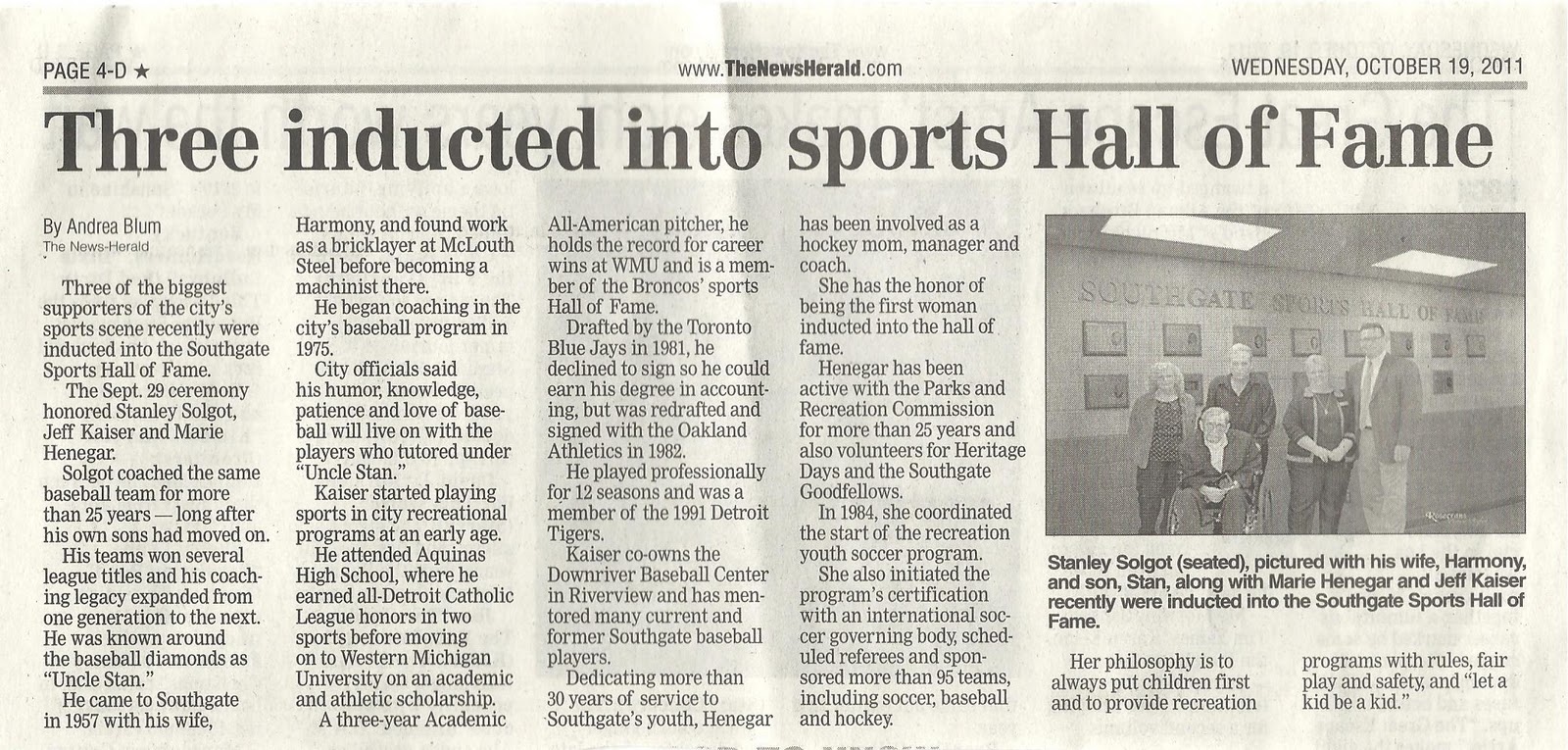
Stanley Solgot

Stanley Solgot, inducted into the 
Southgate Sports Hall of Fame!


Congratulations Stanley!

Oct 11, 2011

Blame It on Babylon


Blame It on Babylon

In the book of Revelation, Babylon is a symbol of all that's wrong in the world. It's the system, the way  things are in a sinful creation. Babylon is worldliness. If you study Revelation 17, you'll notice three things about the prostitute Babylon. First, she is attractive. She has royal clothes, purple and scarlet. She glitters with gold and is decked out in pearls and precious stones. She's got her best threads on, alluring and seductive.

Second, the influence of Babylon in pervasive. She sits on many waters, which are peoples, multitudes, nations, and languages (Rev. 17:15). Babylon the city literally sat on many waters (Ps. 137:1;
Jer. 51:13), but water here is a metaphor for influence. Babylon is connected and powerful. She is not one kingdom in one place at one time but the pervasive worldliness that reigns in every country, every culture, and every government.

Third, Babylon is impressive. John says, in verse 6, "When I saw her, I marveled greatly." He was astonished at her influence, her power, and her hold on the inhabitants of the earth. The ways of the world always seem more impressive than the way of a crucified Savior.

So how do we avoid the crushing weight of Babylon the Great? The first step is to admit we live in Babylon. Everyone does. We are all tempted to drink from the golden cup filled with abominable things (Rev. 17:4). Every culture has it's "isms" to tempt us to idolatry. In Africa, the test of the faithfulness may involve animism and polygamy. In South Africa, it might be syncretistic versions of Catholicism. In Asia, it might be ancestor worship. In America, the "isms" are a little different.

SCIENTISM: truth is only found in what can be measured, tested, and published by peer review.

BIOLOGICAL DETERMINISM: I am what my genes tell me to be.

JOURNEYISM: As long as I keep searching, maybe people will quit bothering me to find something.

EXPERIENCEISM: The good life can be found only through travel, adventure, and novelty.

PROTESTISM: If I always speak out against the evil out there, I can ignore the evil inside.

HEALTHISM: Younger is always better, and when I get old there will be a pill and a workout video to help me feel young again.

ENTERTAINMENTISM: If it doesn't make me feel something right now, it can't be worth my time.

VOYEURISM: My life is disappointing and boring, so I will do all I can to peer in on celebrities whose lives are more exciting and more dysfunctional.

SPORTSISM: I live and die every weekend based on how well twenty-year-old men push each other over while running around in tights chasing a ball.

PARTYISM: Life pretty much stinks most days, but once or twice a week I have the time of my life; later, I throw up.

POLITICSISM: Everything bad is the other guy's fault, and everything that needs to change in the world can be voted on by Congress.

FAMILYISM: Christ and His church take a back seat to soccer and band.

SEXUALITYISM: My parts are my business and God cannot tell me what they're for or when or how to use them.

SHOPPINGISM: It's not idolatry if it's for my kids or on sale.

ADVOCACYISM: I care therefore I am.

I could go on and on about all the other worldly "isms" of our day. But you get the point. We live and breathe worldliness.

The answer is not to hide in a holy huddle in some Christian ghetto. The problem with the Christian subculture isn't that it's too otherworldly but that it's almost always too worldly. Sure, some of the
movies and music change, but the way of thinking is still the same. The experienceism, the healthism, the entertainmentism are all there because finding us an alternative to Babylon is more difficult than watching different movies. It's living by a different story. It's being shaped by a different set of assumptions. It's demonstrating a different ethic. It's being supremely relevant to a dying world by smashing the idol of relevance. If you want to always be relevant, you must deal with the things that touch eternity, and if you are dealing with eternal things, you always seem a bit irrelevant.

We're foolish if we think that we are not surrounded by Babylon. Everyone is. Worldliness in this country will ruin far more spiritual lives than Islam and new-age spiritualities. "In this world, not of the world," Jesus said. Easier said than done. "Can a man carry fire next to his chest and his clothes not be burned? Or can one walk on hot coals and his feet not be scorched?" (Prov. 6:27-28). Beware of all the subtle ways the world wants to squeeze you into its mold.

....by Kevin Deyoung; Senior Pastor of University Reformed Church in East Lansing, MI.
This article taken from Tabletalk Magazine, October, 2011

Mar 15, 2011

Then and only then...

John Stott


“Only he who knows the greatness of wrath will be mastered by the greatness of mercy. All inadequate doctrines of the atonement are due to inadequate doctrines of God and man. If we bring God down to our level and raise ourselves to His, then of course we see no need for a radical salvation, let alone for a radical atonement to secure it.

When, on the other hand, we have glimpsed the blinding glory of the holiness of God, and have been so convicted of our sin by the Holy Spirit that we tremble before God and acknowledge what we are, namely ‘hell-deserving sinners’, then and only then does the necessity of the cross appear so obvious that we are astonished we never saw it before.

The essential background to the cross, therefore, is a balanced understanding of the gravity of sin and the majesty of God. If we diminish either, we thereby diminish the cross.”

John Stott, The Cross of Christ (Downers Grove, IL: InterVarsity Press, 1986), 109-110.

Mar 12, 2011

"I want God and spirituality, but not the church...


"I want God and spirituality, but not the church."


More people say this today than ever. Spirituality is in; church is out. Why? For some, the painful memories of previous church experiences keep them away. For others, church problems aren't worth the hassle. For many, church just "We know that we have passed from death to life, because we love the brethren." A sacrificial love for Christian brothers and sisters is one of the first, best, and more reliable evidences of having passed from spiritual death into eternal life through Christ. Anyone who claims to possess this love for God's people. but avoids their regular gatherings, needs to reexamine his relationship with the Father of this family.

Second, anyone who calls Jesus "Lord" must submit to the authority of His Word when it warns against "forsaking the assembling of ourselves together, as is the manner of some" (Hebrews 10:25). The New Testament knows nothing of the individualized spirituality of today and nothing of a Christianity that exists apart from the local church.

Remember too that the church is Jesus' idea, not man's. More than that, the church is His body. The apostle Paul reminds us, "Christ is the head of the church; and He is Savior of the body," and "we are members of His body" (Ephesians 5:23,30). Even though it may sometimes appear otherwise, the body of Christ has not been severed from its Head; Jesus is still the Head of the church. Why wouldn't anyone want to actively participate in the only organization on earth where Jesus Christ is the Head? When one of His earliest promises was, "I will build My church" (Matthew 16:18), why wouldn't anyone want a part in what Jesus Himself is building?

Look at Jesus' own example. He wasn't a spiritual loner. Twelve disciples always traveled with Him, often teaching and ministering as well. Furthermore, Luke 4:16 reminds us that, "as His custom was, He went into the synagogue on the Sabbath day." Why did Jesus make it His custom to go to the synagogue every Sabbath? Because He would hear the Word of God, worship God, and fellowship with His people there.

That's how participation in congregational spirituality builds our individual spirituality. When we're fed by the preaching and teaching of Scripture, receive the Lord's Supper, sing praises and pray with Christ's people, and talk about the things of God together, the Spirit strengthens us in ways that do not occur when we're alone.

So attend, join, worship in, learn in, give to, fellowship with, and spiritually thrive in a local body of

Christ that's faithful to God's Word. Find teachers and models there who can help with simplifying your spiritual life. Failing this, consider starting some type of small group in the church to discuss or study a book on the subject.

Christian spirituality is not an isolationist, self-absorbed spirituality. True spirituality is relational - not only toward God, but also with the people of God. Proverbs 18:1 teaches, "A man who isolates himself seeks his own desire; he rages against all wise judgment." Don't isolate yourself from the people of God. Take God, spirituality, and the church. That's God's plan. His ways are simpler and healthier for our souls than any we contrive on our own."

Excerpt taken from Simplify Your Spiritual Life by Donald S.Whitney, pages 35, 36

Mar 5, 2011

The Gospel and Prayer

The Gospel and Prayer

"Because I teach and write about spirituality, occasionally I'm asked to comment on scientific studies about the efficacy of prayer. The research always seems to include the assumption that one person's prayers are essentially as acceptable as another's. One of the flaws with such studies is that they do not associate prayer with the gospel.  No one can begin to understand prayer until he grasps what the gospel teaches us about prayer.


The Bible, rather than assuring everyone that God hears their prayers, slams heaven's door against all who think God will hear them despite their sins: 'But your iniquities have made a separation between you and your God, and your sins have hidden his face from you so that he does not hear' (Isaiah 59:2). In one sense, of course, God hears everything. But in this text we're told that God does not hear with a view to answering those who sin against Him. And, of course, since every person except Jesus has sinned against God, the hopes of are dashed of everyone who thinks all it takes for God to hear is for them to pray.

In fact, the Bible is even more shockingly counterintuitive in Proverbs 15:8: 'The sacrifice (which includes the prayer) of the wicked is an abomination to the Lord.'  Many people seem to think, 'It's true, I'm not a dedicated Christian; but if I get into a difficult situation and humble myself to pray, and I'm really sincere, surely God will accept my prayer.'  Or they believe, 'Even though I'm not really a follower of Jesus, if God is merciful and loving, He will look favorably on the prayers of those who come to Him when they're in real need and pray hard enough.'

But this text tells us that, instead of being impressed, the Lord actually abominates these prayers. Why? Because such people believe God should hear their prayers based upon their temporary humility and piety. In other words, they believe their own righteousness - in this case, expressed in a short-lived acknowledgement that they need God's help - obligates God to answer.

Instead of being honored to receive the momentary sincerity of those who want something from Him, God is insulted by their prayers, for they imply that the work of Jesus wasn't necessary. It's as though they're saying, 'The life and death of Your Son weren't needed in my case; it was all a big mistake. I believe You should hear me based upon what I have done - especially in these prayers - and I don't need what Jesus did in order to be heard by You.'  Could anything be more offensive to God?

When it comes to knowing God and being heard by Him, Jesus was unequivocal: 'I am the way, and the truth, and the life. No one comes to the Father except through Me' (John 14:6). Confidence that our prayers are heard cannot come from our sincerity, humility, or need; rather, 'we have confidence to enter the holy places (the presence of God) by the blood of Jesus' (Hebrews 10:19).  Until people come in repentance to God through faith in the person and work of Jesus Christ - who alone can remove the sin that separates us from God - their prayers will not be answered.

Does God ever answer the prayer of a non-Christian? Many stories claim that He does. In reality, are these 'answered prayers' simply God doing in His providence what He was going to do regardless of the prayers? The clearest ground biblically is this: except for those prayers leading to salvation, we can give no assurance to anyone outside of Christ that God will answer his prayer. It is only through the gospel that we truly begin to pray for only then - after Jesus has made us and our prayers acceptable to the Father - do the promises of prayer in the Bible apply to us.

Once we respond to the gospel in repentance and faith and are adopted into God's family, our newly begun relationship with our heavenly Father becomes markedly prayerful. No longer is prayer just an obligation or a hoop to jump through to get what we want, for the gospel makes prayer a desire and not a mere duty. Through the gospel we receive the Spirit who causes us to cry, 'Abba! Father! (Romans 8:15; Galatians 4:6) with a new heavenward, Fatherward orientation. In other words, the Spirit of God causes us to want to talk to God.

Prayer should still remain a discipline, for even with the God-given desire to pray, it's easy to be distracted from habits of prayer by the crush of the responsibilities. But thanks to the grace of God in the gospel, our prayers are always welcome."

Article taken from Tabletalk Magazine, March, 2011
Written by Donald S. Whitney, senior associate dean of the school of theology and professor of biblical spirituality at the Southern Baptist Theological Seminary.

Oct 30, 2010

Final Judgment by John Sartelle


Final Judgment
-John Sartelle-

"It is the Lord who judges me" (I Cor. 4:4). Evangelical Christians have a proclivity to pronounce judgment on all things pertaining to our Lord's church. We treat this as a right and an obligation. It begins most Sundays over lunch, or in the car on the way home, or perhaps in the church foyer after the service.

We pronounce commendations and condemnations on the music, Sunday school teachers, sermons, choirs, ministers, elders, and deacons. Sometimes that judgment renders a commendation that lifts individuals to a completed sanctification or a condemnation that exiles others to a region in the vicinity of purgatory.

In 1 Corinthians 4:1-5, Paul warns us of the danger of declaring such verdicts. He reminds us that Jesus is the judge of anything associated with His church. Thus, we are usurping His position when we deliver these rulings. Let's imagine for a moment that we have been transported to the final judgment. The world has already received that justice that cannot be appealed. The sentence from which there is no parole has been executed. The holy, catholic, apostolic church stands before her Lord and Judge to receive commendations and scathing reviews that will burn away the worthless word, hay and stubble of our trivial endeavors (3:12-15). At that moment, who would step forth to correct or otherwise amend His evaluations? Who would suggest: "Jesus, You need to step aside and let me sit on the throne. I think I am better able to assess these matters"? Who would raise his hand and demand to be a counselor to the Judge? That is what we do when we pronounce other Christians hold or unholy. We put ourselves in the place of the Lord of heaven and earth.

In the church, we are servants of Christ (4:1). In serving Him, we are to serve each other, even washing the dirty feet of our brothers and sisters. Paul reminds us that Christ alone is the Master. We, however, as servants hand our acclamation or defamation to other servants as if ours is the approval or disapproval that matters. As a minister, I am guilty of courting the praise of others more than the approbation of Christ. If given space, this inclination will grow into a habit, and I will make decisions in order to please the crowd instead of Christ. At the final judgment, the applause of people, the acclaim we so avidly sought, will seem trifling and detrimental. Likewise, the one given to judging fellow saints will unwittingly encourage his "judges" to seek his approval more than Christ's.

Who among us is able to perceive the motives and purposes of the deepest recesses of the heart? The minister or elder who worked tirelessly may have been chiefly motivated by a desire to rise to a place of power. The one who seemed so humble, may have been totally motivated by a raging fire of pride in his inner being. The pastor whom we thought should have been more of an extrovert and more visible in the community may have been the quiet priest who spent hours on his knees daily for his city and flock. This is why Paul said, "Therefore do not pronounce judgment before the time, before the Lord comes, who will bring to light the things now hidden in darkness and will disclose the purposes of the heart (v.5). He, alone, is omniscient and just.

How do we live our daily lives waiting patiently and compassionately in anticipation of His judgment? We can live moment by moment through the day thinking that the Lord may return in the next hour. We can live through details of the week knowing that judgment will certainly come. In the darkness of this world, we can live anticipating the light of His judgment. Such thoughts are not morbid but are filled with wisdom. We will be prompted not to live and die for the approval of those whose opinions are neither healthy nor absolute. We will be reminded to refrain from judgment as we are neither sovereign nor omniscient. We will be fearful of assuming the judgment seat that belongs to Him alone.

We have a taste of that final judgment now as His Word cuts into the depths of our being: "For the word of God is living and active, sharper than any two-edged sword, piercing to the division of soul and of spirit, of joints and of marrow, and discerning the thoughts and intentions of the heart. And no creature is hidden from His sight, but all are naked and exposed to the eyes of Him to who we must give account" (Heb. 4:12-13). Sometimes His Word exposes our innermost sins and, by the power of His Spirit, cleans out the dirt. At other times, His Word commends and encourages as we reflect His glory in the darkness of this world. One day a final accounting will be given. His Word will surgically remove all vestiges of our sin nature, and we will hear Him acclaim the battle-worn warriors to His Father. That is the day we should ever keep in mind, and we should live, even now, in its light. Certainly, it will be a fearful time. Yet that day will be more sweet than any previous, for there will be no more sin as we live in communion with Him in a restored creation that has been set free from decay and bondage.


-Article taken from Tabletalk Magazine, Nov. 2010-

Apr 20, 2010

He Who Has Ears


He Who Has Ears . . .
by Scott Anderson


Everyone loves a story. Whether young or old, we all enjoy hearing, reading, or seeing a good story unfold.

Stories are remarkably powerful things. They stir up our imaginations and excite our affections. They instruct us and inspire us. They intoxicate and influence us. They linger with us, often becoming more precious and poignant and powerful over time.

In seminary every pastor-in-training learns about the mysterious homiletical power of story and illustrations. How many times has a church congregation snapped back to attention during a sermon because the preacher began recounting a story or explaining his point with a descriptive, sensory-filled illustration? And why do good preachers do this? Because the human heart is spring-loaded to respond to stories and illustrations. Many times, long after the spoken words are forgotten, we can still call to remembrance the main point of a sermon because of the wise and effective employment of a good story.

During His earthly teaching ministry, the Lord Jesus, who was the master teacher and preacher, often used stories and illustrations as He instructed the crowds of people who flocked to hear Him. Most scholars refer to these types of stories as "parables." There are about fifty different parables of Christ recorded in the Gospels. In fact, about one-third of all of Jesus' recorded sayings are parables. This would seem to imply something very interesting: telling stories was one of Jesus' favorite methods for "proclaiming and bringing the good news of the kingdom of God" (Luke 8:1) and speaking forth "the words of eternal life (John 6:68).

The word parable communicates the idea of placing one thing by the side of another, and from this meaning you can easily figure out how they work: simple terms are used to convey a profound truth. In the ministry of Christ, parables are simple stories taken from the familiar world in which Jesus lived, and they are told to relate an unfamiliar spiritual truth. The common, mundane, and everyday are used to elucidate the uncommon, profound, and other-worldly. One person has said that a parable is "an earthly story with a heavenly message." And while the parables of Christ are not strict allegories (in which every minor detail is symbolic of something else), they are brief, simple illustrations that usually address one problem or question with which our Lord was dealing. In other words, parables usually drive home one main truth.

But you might be wondering, why parables? Well, you would not be the only one to have asked that question. After hearing Jesus tell the parable of the soils, "the disciples came and said to him, 'Why do you speak to them in parables?'" (Matt. 13:10). The reply of our Lord is very interesting:

"And he answered them, 'To you it has been given to know the secrets of the kingdom of heaven, bu to them it has not been given. For to the one who has, more will be given, and he will have an abundance, but from the one who has not, even what he has will be taken away. This is why I speak to them in parables, because seeing they do not see, and hearing they do not hear, nor do they understand.

But blessed are your eyes, for they see, and your ears, for they hear'" (vv. 11-13, 16).

You see, Christ was speaking to a mixed-multitude. There were those who received His teaching with open hearts, and those who spurned His truth and persisted in unbelief. Rather than try to weed-out the believers in order to instruct only them, Christ set His teaching before the crowds in the form of parables. Those who had hearts to believe would embrace the teaching and seek to understand further, and those who rejected it, even though they had heard, would not understand at all. In this way, parables withdraw the light from the rebellious at heart who hate the truth, and give light to those who believe and love the truth.

The implication of this is profound: more than a mere homiletical device or a powerful didactic tool, the parables of Jesus are actually designed to help us see whether illuminating grace is on the move in our lives. (Whether we fully understand every nuance of a given parable is not the main concern - even the disciples had to have some interpreted for them.) Parables function as little tests of faith, beckoning us to see and believe and obey the truth of the Storyteller.

So as we seek to be the church in this world, let us eagerly read the parables of Jesus - and all of God's Word - with a humble dependence on the gracious, illuminating work of the Holy Spirit. Let us as these kinds of questions: Am I embracing Christ as the ultimate good of the gospel today? Am I open to His teaching? Am I joyfully abiding in His instructions? Am I really interested in His truth? Do I have eyes that want to see and ears that want to hear the words of life?

In reading this way, we will become joy-filled partakers of the great story to which the gospel has so graciously called us, and the Word of God will become a deep well of life-giving truth that provides rich, spiritual satisfaction for our souls.

Scott Anderson is director for networking and partnership for Desiring God Ministries in Minneapolis, MN. This article taken from Ligonier Ministries' Tabletalk Magazine, April, 2010.

Our pastor, Bill Connell, is currently in the process of teaching from the Parables of Jesus. If you'd like to listen to past sermons, go to our web site at http://www.gracebiblesouthgate.org/; click on Recent Sermons and select the sermon you'd like to hear. You're also invited to join us each Sunday morning to hear Pastor Bill in person as he continues this series.


Apr 16, 2010

Do Your Prayers Shake the Earth?


Do Your Prayers Shake The Earth?
John P. Sartelle


"And the smoke of the incense, with the prayers of the saints, rose before God from the hand of the angel" (Rev. 8:4). God loves to hear His children speak to Him. As the architect of the tabernacle and temple, He designed the altar of incense as an integral part of worship. The burning of incense produced a fragrant aroma that was symbolic of the prayers of His people: "And when he had taken the scroll, the four living creatures and the twenty-four elders fell down before the Lamb, each holding a harp, and golden bowls full of incense, which are the prayers of the saints" (Rev. 5:8).

There was a set time of day when the priest would ignite the incense on the altar; it was when the worshipers gathered to pray (Luke 1:10). Through this ritual God's message is clear: "Your prayers are like a sweet bouquet to Me."

I am the father of three married children who now live some distance away. When I see one of their phone numbers appear on my caller identification, a joy spontaneously erupts. I love to hear their voices. I am eager to hear their words. My Father is like that with my prayers, with my words to Him. I am saddened that my sinful heart is sometimes not so fervent to speak with Him. Dear Father, move upon my soul and make me as eager to speak to You as You are to hear me.

True prayer positions us in a holy place. The prayers of Revelation 8:1-5 are before God on His throne. These prayers are in the real Holy of Holies. The great angels are there. His court, in its glory and majesty, is the site of our prayers. Prayer is not a casual conversation between peers. Prayer is daring to converse with the Almighty, the Creator of the galaxies, the Lord and Ruler of all that is or ever will be. There is a dearth of reverence in modern evangelical worship. I fear that same drought of holy fear is absent from our times of prayer. The apostle John noted in his vision: "There was silence in heaven for about half an hour" (v.1). The silence was a holy hush as entreaties ascended to Jehovah.

True faith teaches us to wait on the Lord in our prayers. The prayers in these verses were offered on previous occasions by the martyrs (Rev. 6:10). God instructed them to rest for a time in the certainty that their requests would be addressed in the future. My father prayed early in the morning every day. A few years before he died, I expressed my concern that after he went home I would no longer be covered by his daily prayers. He corrected my faulty theology, saying "John, all the prayers I have for you since you were a baby are still before the Lord - and will be long after I am gone."

God takes the prayers of His children and shakes the earth: "And the smoke of the incense, with the prayers of the saints, rose before God from the hand of the angel. Then the angel took the censer and filled it with fire from the altar and threw it on the earth, and there were peals of thunder, rumblings, flashes of lightening, and an earthquake" (Rev. 8:4-5). God takes the prayers of His people and throws them to the earth effecting a storm of thunder and lightening and even a fearsome earthquake. Eugene Peterson in his book Reversed Thunder gives a summary picture of the scene: "The prayers which had ascended, unremarked by the journalists of the day, returned with immense force in George Herbert's phrase, as 'reversed thunder.' Prayer reenters history with incalculable effects. Our earth is shaken daily by it."

There is a picture of this 'reversed thunder' in Acts 4. Peter and John were arrested in the very early days of the church after Pentecost. They were taken before the Sanhedrin and faced the same men who plotted the crucifixion of Jesus. Their courage was impressive, but the court strongly threatened them against any further mention of Jesus. When they safely returned to their fellow Christians, the prayer of the congregation was for boldness in response to the world's power: "And now, Lord, look upon their threats and grant to your servants to continue to speak your word with all boldness" (Acts 4:29). How did God answer their prayer? "And when they had prayed, the place in which they were gathered together was shaken, and they were all filled with the Holy Spirit and continued to speak the word of God with boldness" (v.31). God replied with an earthquake. He wanted them to know that their prayers could shake the earth. It is as if the incense is changed and thrown back to the world as dynamite.

When I read passages like this I do think we play at praying. We know of John Knox as a preacher. However, it was not his preaching that Mary, Queen of Scotland, feared. She confessed, "I fear the prayers of John Knox more than all the assembled armies of Europe." She may not have known the theological foundations of prayer, but she did know the effects of his prayers.

God revealed to a persecuted and suffering church in Revelation: "There is power in prayer - power that can shape history and shake the earth." Does the world fear our prayers?


Rev. John Sartelle is senior minister of Tates Creek Presbyterian Church in Lexington, Kentucky. This article is taken from Tabletalk Magazine, Ligonier Ministries, Orlando, FL.