Oct 30, 2012

Oct 15, 2012

Thinking Like Jesus


Thinking Like Jesus
 
 
Several years ago, I was asked to give a convocation address at a major theological seminary in America. In that address, I spoke about the critical role of logic in biblical interpretation, and I pleaded for seminaries to include courses on logic in their required curricula. In almost any seminary course of study, students are required to learn something of the original biblical languages, Hebrew and Greek. They are taught to look at the historical background of the text, and they learn basic principles of interpretation. These are all important and valuable skills for being good stewards of the Word of God. However, the main reason why errors in biblical interpretation occur is not because the reader lacks a knowledge of Hebrew or of the situation in which the biblical book was written. The number one cause for misunderstanding the Scriptures is making illegitimate inferences from the text. It is my firm belief that these faulty inferences would be less likely if biblical interpreters were more skilled in basic principles of logic.
 
Let me give an example of the kind of faulty inferences I have in mind. I doubt I have ever had a discussion on the question of God's sovereign election without someone quoting John 3:16 and saying, "But doesn't the Bible say that 'God so loved the world that He gave His only begotten Son that whosoever believes in Him should not perish but have everlasting life'"? I immediately agree that the Bible says that. If we were to translate that truth into logical propositions, we would say that all who believe will have eternal life, and no  one who has eternal life will perish, because perishing and eternal life are polar opposites in terms of the consequences of belief. However, this text says absolutely nothing about human ability to believe in Jesus Christ. It tells us nothing about who will believe.  Jesus said, "No one can come to me unless the Father who sent me draws him" (John 6:44). Here we have a universal negative that describes ability. No person has the ability to come to Jesus unless a particular condition is met by God. Yet this is forgotten in light of John 3:16, which says nothing about a prerequisite for faith. So, John 3:16, one of the most famous texts in all of the Bible, is routinely, regularly, and systematically butchered with faulty inferences and implications.
 
Why do such illegitimate inferences happen? Classical Christian theology, particularly Reformed theology, talks about the noetic effects of sin. The English word noetic derives from the Greek word nous, which is often translated as "mind". So, the noetic effects of sin are those consequences of the fall of man on the human intellect. The entire human person, including all of our faculties, was ravaged by the corruption of human nature. Our bodies die because of sin. The human will is in a state of moral bondage, in captivity to the evil desires and impulses of the heart. Our minds, likewise, are fallen, and our very ability to think has been severely weakened by the fall. I would guess that Adam's IQ before the fall was off the charts. I doubt that he was given to making illegitimate inferences in his time of tending the garden. Rather, his mind was sharp and acute. But he lost that when he fell, and we lost it with him.
 
However, the fact that we are fallen does not mean that we no longer have the ability to think. We are all prone to error, but we also can learn to reason in an orderly, logical, and cogent fashion. It is my desire to see Christians think with the utmost cogency and clarity. So, as a matter of discipline, it is much to our benefit to study and master the elementary principles of reasoning so that we can, by the help of God the Holy Spirit, overcome to a certain degree the ravages of sin upon our thinking.
 
I do not think for a moment that any of us, as long as sin is in us, will ever become perfect in our reasoning. Sin prejudices us against the law of God for as long as we live, and we have to fight to overcome these basic distortions of the truth of God. But if we love God, not only with all of our hearts, our souls, and our strength, but also with our minds (Mark 12:30), we will be rigorous in our attempts to train our minds.
 
Yes, Adam had a keen mind before the fall. But I believe the world has never experienced such sound thinking as was manifested in the mind of Christ. I think that part of the perfect humanity of our Lord was that He never made an illegitimate inference. He never jumped to a conclusion that was unwarranted by the premises. His thinking was crystal clear and coherent.
 
We are called to imitate our Lord in all things, including His thinking. Therefore, make it a matter of chief and earnest business in your life to love Him with all your mind.
 
Dr. R.C. Sproul
Article taken from Tabletalk Magazine, Oct. 2012

Oct 12, 2012

Corrie Ten Boom


“When a train goes through a tunnel and it gets dark, you don't throw away
the ticket and jump off.
You sit still and trust the engineer.”
~Corrie Ten Boom


"Trust in the Lord with all your heart and lean not on your own understanding;
in all your ways submit to him, and he will make your paths straight."
~Prov. 3:5-6


Oct 10, 2012

Beautiful Creation


What a beautiful creation!
"The God who made the world and everything in it is the Lord of
heaven and earth..."
 ~Acts 17:24~


Oct 6, 2012

What if....


"Behold, I am the LORD, the God
of all flesh; is there any thing too hard for me?"
(Jeremiah 32:27)

Oct 5, 2012

Can a Christian Vote for a Non-Christian Candidate?

"I urge, then, first of all, that petitions, prayers, intercession and thanksgiving be made for all people – for kings and all those in authority, that we may live peaceful and quiet lives in all godliness and holiness".

– 1Timothy 2:1-2


It is clear from the Apostle Paul’s writing that we are to pray for all leaders in government, including those who may not be Christians. But can we vote for them?

Theologian Wayne Grudem writes in Politics According to the Bible, “Christians should support the candidates who best represent moral and political values consistent with biblical teaching, no matter what his or her religious background or convictions.”

There are many biblical examples of God bringing non-believers to work alongside His people to further His purpose:

- Genesis 41:37-57 - God used Pharaoh to establish Joseph in a position of authority in Egypt.

- 1 Kings 5:1-12 – Hiram, King of Tyre helped Solomon build the Temple.

• Daniel 2:46-49 - Nebuchadnezzar placed Daniel and his Jewish friends in positions of high authority in Babylon.

- Isaiah 45:16 – Cyrus, King of Persia, restored the Jewish exiles to Israel.

- Isaiah 45:16 – Cyrus, King of Persia, restored the Jewish exiles to Israel.


This working together with non-believers is called co-belligerence. Christian apologist Francis Schaeffer writes, “A co-belligerent is a person with whom I do not agree on all sorts of vital issues, but who, for whatever reasons of their own, is on the same side in a fight for some specific issue of public justice.”

There are many other examples of co-belligerence. William Wilberforce joined with non-believers to abolish the slave trade in England. Our country’s Christian Founding Fathers joined with their non- Christian counterparts, men like Jefferson and Franklin, to establish the foundations of a new nation.

There will be times that God calls us to engage in co-belligerence for the furtherance of His Kingdom. We may be required to vote for a non-Christian to help us accomplish God’s design for our time.

Al Mohler, President of The Southern Baptist Theological Seminary writes: “We must be honest and acknowledge that there are non-Christians or non-evangelicals who share far more of our worldview and policy concerns than some others who identify as Christians. The stewardship of our vote demands that we support those candidates who most clearly and consistently share our worldview and combine these commitments with the competence to serve both faithfully and well.”

Theologian Dr. John Frame writes in Doctrine of the Christine Life: “…in some cultures (like the ancient Roman, in which the New Testament was written) there is not much that Christians can do, other than pray, to influence political structures and policies. But when they can influence them, they should. In modern democracies, all citizens are ‘lesser magistrates’ by virtue of the ballot box. Christians have an obligation to vote according to God’s standards. And, as they are gifted and called, they should influence others to vote in the same way.”

Christians need to vote responsibly. We have an obligation to be informed about issues and candidates, and then vote for those whose stances most closely align with biblical principles. As voters, we share the responsibility of government and thus share accountability to God for what takes place in our nation. And yes, this may mean that at times we need to vote for a non-Christian, whether it’s a national, state or local race.

There are many Christian brothers and sisters who feel anxiety about whether or not they should support Mitt Romney given that he is a Mormon. While I share their belief that Mormonism is not a Christian faith, biblical teachings reveal that I am to be civically responsible, and in America, that includes voting. Regular readers of my column know that Governor Romney was not my first choice for president. But the fact is, one of only two men will be the next President of the United States: Barak Obama or Mitt Romney. Obama’s own record as a senator and now president reveals a man who believes in doctrines that are decidedly antithetical to Christianity and basic conservative morality. And a new documentary, 2016: Obama’s America (which I have recently seen and am now helping to promote) makes it crystal clear that Obama is also working to remake America into something very different than what our Framers designed when they wrote the Constitution. Romney, while far from perfect, has got to win this election if we are going to have any hope of preserving biblical morality or the American dream. I never look for the best Christian to be President – I look for the one who best reflects a strong moral character, and who is most likely to preserve my rights as a Christian and freedom-loving American.

Written by Rebecca Hagelin

www.Townhall.com

Psalm 105:4

Until He Will

“Until He Will”


"Cast not away therefore your confidence, which hath great recompence of reward. For ye have need of patience, that, after ye have done the will of God, ye might receive the promise".
Hebrews 10:35-36 KJV

I recently drove to the airport to pick up a friend. I left the house allowing enough time to get to the airport by 12:30 in the afternoon. I arrived on time and so did the plane. I could have gone to the airport at 9:00 AM but I would have been early. I could have gone to the airport at 3:00 PM but I would have been late. My trip was dependent upon the time the airline had scheduled the plane’s arrival, not upon when I wanted to go to the airport.

As we obey God and do His will, it does not mean that things will go according to our timetable. God has His own timetable and He is never late. He does not set His clock according to our schedule; He does not make His plans according to our counsel; He does not fulfill His promises according to our understanding.

Years ago, my dad was anxious to see God open a specific door of ministry for him. Often, as a matter of prayer, he would petition God to answer the desire of his heart. The answer didn’t come as quickly as my dad had hoped and he began to fret about the matter. One day, while in his quiet time, he heard the Lord speak these words, “Until I will, be still.” Immediately, God’s loving assurance quieted his fretting heart. These words made such an impact upon him that he wrote them down and tacked them up on his office wall. For many years this note was as a reminder of God’s faithfulness to His promises and to God’s timetable in my dad’s life.

The lasting fruit of “Until I will, be still,” became evident to me many years later when my dad came to visit us in Arkansas. We had a great time together, and my dad had many opportunities to minister to many of God’s people who lived in our area.

When the day came for my dad to return to Los Angeles, we drove him to the airport. Upon arriving at the gate, we discovered that the flight he was scheduled to take had been canceled. I will never forget his response. There was no complaint, no sigh of disgust, no murmuring, no protest. Quietly and calmly he turned to me and said, “That’s okay, God must still have some ministry for me before I leave.” It was evident that my dad had fully learned to rest in God’s timetable, and it turned out that God did have one more ministry opportunity for my dad before returning home.

Are you waiting on God to fulfill a dream or to bring about a promise? Joseph had a divine dream that his brothers would bow down to him, but it took 20 years before Joseph saw that dream fulfilled; Abraham was given God’s covenant promise that through his heir all the families of the earth would be blessed, but it took 25 years before Isaac, the child of promise, was born. Both Joseph and Abraham saw God’s answer in God’s appointed time.

What do you do while you are waiting upon God’s answer? Here are a few things not to do—don’t be discouraged, don’t lose hope, don’t cast away your confidence, and don’t set out on your own to try and make things happen.

Here are a few things you can do— continue to do God’s will, continue in your appointed place, continue to be faithful, continue to trust and be thankful, and continue to rest in His unfailing promises. “Until He will, be still.”

Written by Roy Lessin

Sep 27, 2012

Gratitude

"But even the hairs of your head are all numbered.
Fear not, therefore; you are of more value than many sparrows."
~Matt. 10:30-31~


Sep 1, 2012

Labor Day

Knowing the Shepherd

Knowing the Shepherd,
The Shepherd Knowing You


I am the Good Shepherd; and I know My sheep, and am known by My own.
My sheep hear My voice, and I know them, and they follow Me.
John 10:14-15 NKJV


Knowing His voice means you will hear the voice of clarity and not confusion; you will know the voice of peace and not the voice of anxiety; you will be instructed by the voice of wisdom and not the voice of folly; you will be told the way of holiness and not the way of sin; you will be instructed with the voice of good counsel and not the voice of bad advice; you will know the voice of light and not the voice of darkness; you will know the voice that takes you on a straight path, and not the voice that brings you to a dead end; you will hear the voice of truth and not the voice of deception.

Knowing that He knows you means that He knows you personally and will not confuse you or your needs with another sheep in His flock. His eyes see all the sheep of His fold and yet His eye is personally on you. He knows where you are and will guide you; He knows your fears and will keep you safe; He knows your hunger and He will feed you; He knows your weariness and will give you rest; He knows your valleys and will bring you through; He knows your enemy and will defend you; He knows your dwelling place and will safely bring you home.

by Roy Lessin


Aug 30, 2012

2 Corinthians 4:18

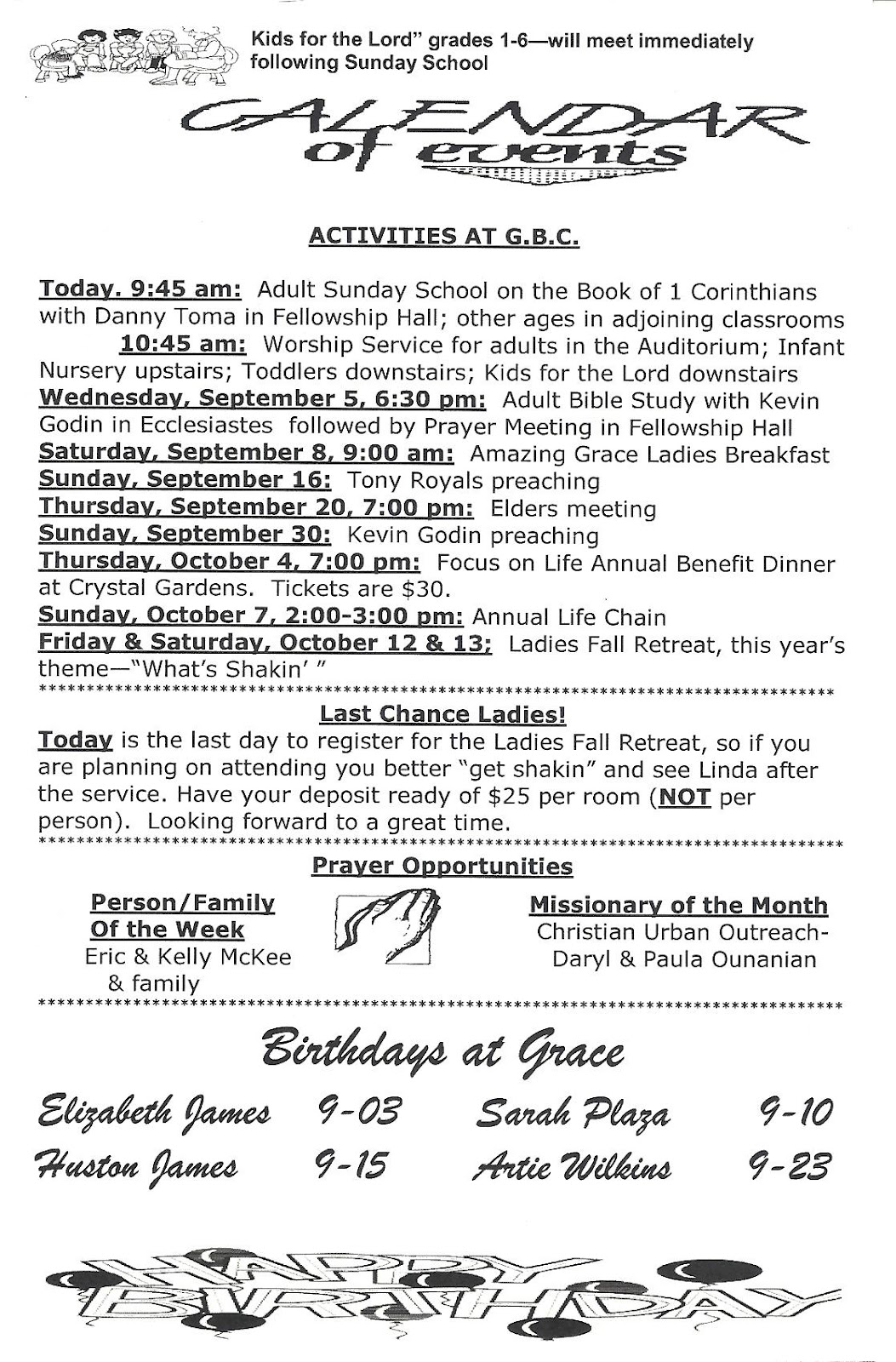
Amazing Grace Women's Breakfast

Amazing Grace Women's Breakfast

The "Amazing Grace" Women's Breakfast will be
starting up again on
Saturday, September 8th, 2012.
We will meet at Little Daddy's Restaurant on Eureka, in Taylor
(Next door to Southland Mall) at 9:00 AM, or as soon as you can make it.
Join us as we talk and enjoy each others company and of
course eat breakfast.
Encourage a friend to come.
Hope to see you there!


Aug 5, 2012

Bulletins, Sunday, August 5, 2012


The Church and Idolatry

The Church and Idolatry

"Now set your mind to see the LORD your God" I Chron. 22:19. All sin is idolatry because every sin is an exercise in trust of something or someone other than the one true God to satisfy, fulfill, or bless. It is not difficult to see how violations of commandments two through ten are automatic violations of commandment one. This truth reveals that the "hottest war" going is the one taking place in the sanctuary of our own hearts. But we must wage this war because none of us is a bystander to idol worship.

In Isaiah 44:12-17, we find a powerful and revelatory description of just how easy it is to slip into idolatry. We see in the passage that ironsmiths are simply working their tools over the coals, fashioning them with their hammers. Carpenters measure out cuts and notches. Artists capture the physical form in sketches and sculpture. Men chop down trees to build houses, then plant more trees to replace them. They build fire, bake bread. Ah, look at what we've created.

The transition is seamless from everyday, workaday living to "he makes a god and worships it; he makes it an idol and falls down before it" (v. 15). Of the same fire he has used for warmth and cooking, the workman says, "Deliver me, for you are my god!" (v. 17).

The move is subtle. The switch from ordinary human achievement to blasphemy requires no explanation. It just flat-out happens. Isaiah 44:12-17 demonstrates that there is only one step to becoming an idolater, and it is simply to mind your own business.

The implication for our churches is huge. On Sundays, our sanctuaries fill with people seeking worship, and not one person comes in set to neutral. We must take great care, then, not to assume that even in our religious environments, where we put the Scriptures under so many noses, that it is Jesus the exalted Christ who is being worshipped.

Every weekend in churches everywhere, music is performed to the glory of human skill and artistry. Once upon a time, I sat through a little ditty in a church service in which the congregation was led to sing, "I can changed the world with these two hands," and the question struck me like a lightning bolt: "Who exactly am I worshipping right now?"

Likewise, every weekend men and women file into church buildings in order to exult in the rhetorical skill of their preacher, to admire him and think of their church as his church, not Christ's church. Many of us file in each week to enjoy the conspicuous spiritual exercises of our brethren. We worship the worship experience.; we tithe with the expectation of return from heaven's slot machine; we dress to impress; and we serve and lead to compensate for the inadequacies in our hearts that only Christ can fill.  Every weekend, hundreds of preachers extol a therapeutic gospel from the pages of the same Bible where the real gospel lies. We Reformed are not exempt, as too often our affections are poured totally into doctrine with only vague admiration reserved for the doctrine's Author.

A church will become idolatrous in a heartbeat because it's already there. So, we cannot set our worship on autopilot. We cannot mistake the appearance of busy religiosity for worship in spirit and truth. We see in Exodus 32:5 that even the worshipers of the golden calf ascribed their worship to the covenant Lord Yahweh.

The gospel imperative, then, is to return again and again to the gospel indicative. Our first I duty is "gospel obedience" (Rom. 10:16; 2 Thess. 1:8; 1 Peter 4:17), which is to stand at attention to Christ upon the gospel's "ten-hut." Our hearts and minds flow through the rut of idolatry, but the deliberate proclamation of Jesus at every possible turn will force us off our idolatrous course. Martin Luther advises us:

I must take counsel of the gospel. I must hearken to the gospel, which teacheth me,
not what I ought to do, (for that is the proper office of the law), but what Jesus Christ the Son of God hath done for me: to wit, that He suffered and died to deliver me from sin and death. The gospel willeth me to receive this, and to believe it. And this is the truth of the gospel. It is also the principal article of all Christian doctrine, wherein the knowledge of all godliness consisteth. Most necessary it is, therefore, that we should know this article well, teach it unto others, and beat it into their heads continually.

Tim Keller elaborates: "So Luther says that even after you are converted by the gospel your heart will go back to operating on other principles unless you deliberately, repeatedly set it to gospel-mode."

The proclamation of the good news of Jesus and the extolling of His eternal excellencies is always an interruption, always a disruption. It alone will bring the sword of division between where even our religious hearts are set and where they ought to be.  For this reason, we cannot go about minding our own business any more. We must mind God's (Col. 3:1-4).

by Jared C. Wilson, Tabletalk Magazine, June, 2012

Rev. Jared C. Wilson is pastor of Middletown Springs Community Church in Middletown Springs, Vermont, and author of the books Your Jesus is Too Safe and Gospel Wakefulness.